How I felt (personally) about the Amazon Rainforest was a mixture of feelings from excited to scared (having learnt beforehand – in Costa Rica on a wildlife walk – about the 2 most poisonous snakes in the Amazon Rainforest: Bush Master and Ferdilance). The idea of going to the Rainforest wasn’t high on my list of places to go, but actually going and being there made me change my mind completely.
Going to the Rainforest made me think about how important it is to save this type of landscape. Our guide Dan, quoted that “cutting down only one tree may cause destruction for more than a hundred living specie of birds, bugs and even snakes”. That made me realise how many people need to cut down trees for living and have no choice but to saw more than 50 trees per day and if there’s ten people cutting down trees it would make 500 trees being cut down at the same time, that only 1% of the trees cut down per day.
During Covid, there was a negative impact on the communities in Ecuador. Tourism fell and this affected the indigenous people who rely on eco tourism. They had no way to make money. People from other areas of Ecuador, came to them and offered them money to chop down the Balsa Trees on their land. Balsa wood is very strong and very light. It is used to make the wings on giant wind turbines. Lots of trees got cut in the last two years as a result. Ironically they are used to create alternative wind energy to help reduce our dependence on fossil fuels.
Uncontacted Tribes
Its hard to believe that some people don’t know about the world like we know it. For example, they don’t know that the world is round, they don’t know that they live in Ecuador or South America, they don’t know about technology like cars, or the internet, that there are other languages aside from theirs. I could go on but you get the idea. Uncontacted in this sense means that they haven’t had any contact with anyone from the outside world. And this through choice. Oil workers or missionaries who go eagerly into the parts of the rainforest where the uncontacted tribes live in peaceful harmony within the amazon’s fragile ecosystem, never come out (having probably been gruesomely slaughtered by a spear).
Indigenous, but having contact with humans from the outside world.
On the last day of our trip, we visited an indigenous tribe and saw how differently they do their schooling, cooking, houses and overall living. They only get education up until they are 14 and from the age of 5 most children walk around 2 hours to and then back from school alone as the community is very spread out. Their houses are made of wood and the roofs are made of dried palm leaves sewn (by hand) firmly into tight plaits which eventually turn into parts of the roof. We also learnt about how they traditionally used to hunt in the forest. Children still get taught how to master the art of blow pipe and poison darts.
Eating Traditional Food
After talking through how they did their schooling, they wanted to give us a taste of their traditional food which was a plate of fish, coco bean, a nut, a white piece of coconut and Larvae (I did not eat this particular piece of food having been shown the squirming bug a few minutes before). Phoenix on the other hand took ages but eventually gave in and swallowed it. He bravely picked up the larvae having heard from the others that it tasted like ‘bacon’ but then took rather a long time to actually swallow it. Finally, after having watched him swallow it with a proud, sick impression, we ate the rest of the food and bid goodbye to the lovely people.
Oil vs Eco Tourism
One of the ways Ecuador makes money is via its oil reserves. It’s surprising that a rainforest like the Amazon would have oil underneath it. The industry was very apparent as we journeyed into the Amazon. There were large areas of land cleared for oil extraction.
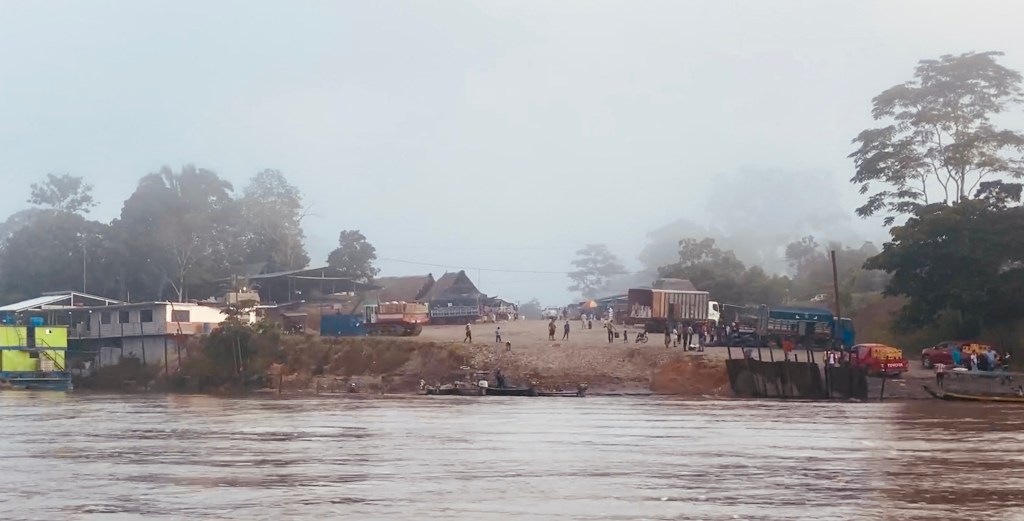

There were many tankers on large boats going up and down the river. This has increased and become a real issue in the last couple of decades. Indigenous people are offered a lot of money to give up their land for oil. Their alternative is to either avoid any contact like the ‘Uncontactables’ or as we met, the people who are finding a way with sustainable eco tourism.
 Sky Yonder
Fantastic writing Sorcha…you are learning so much about the world first hand and nothing is better than that
I loved reading about your trip to the indigenous people and finding out about how they live and their world which is so different from the one in which we all live in! I think they might be happy though!
Eating the food was a little bit worrying and like you I’m sure I would not have liked the bug thing… but we eat prawns and crabs🤷♀️ Same thing really!
The oil extraction problem is not such a good thing and hopefully it can be solved before it’s too late!
Love your writing darling … just keep it coming!
Love you xxx
LikeLike