At the end of a remote bumpy unpaved road on the edge of Lago Arenal, we arrived at Rancho Margot. We were in search of a different kind of experience, something that would inspire and maybe help us to make the most of our opportunity with our own land back in Dartmoor. We were not disappointed!
The farm was created by Juan Sostheim who, after an international career working for some big companies, decided to take a different, healthier path and make his home in Costa Rica. He purchased some 400 acres of remote cattle pasture on the edge of the protected Monteverde Children’s Eternal Rainforest. He set about protecting wildlife, planting trees and plants on the majority of the land to create a ‘functional forest’ as well as creating a hotel (of sorts) and a progressive sustainable, self-sufficient farm.
Upon arrival you are struck by the passion and dedication of all who live and work here – there is real pride and passion in the eyes of everyone you meet. Nothing can prepare you for the way you are going to be completely bowled over by the place. Everyone mucks in and works a range of jobs. Moreover, there’s also a sense of urgency, of real purpose, of making the world a better place; to such an extent, you feel as a guest that you just want to get out in the garden and help too.
It’s not a hotel in the traditional sense. The ‘luxury’ cabins dotted within tropical gardens are basic but comfortable and totally in keeping with the place. You instantly feel close to nature and it’s almost entirely off the grid save for a slow satellite modem connection near the main office. The first thing you notice is the cacophony of bird song and you can easily while away an hour lying on your hammock watching the bird activity within a few metres of your cabin. Yet I felt uncomfortable’ relaxing when everyone around you had a higher purpose

This place is important. It’s a place to come and experience a different way of living, a place to inspire, learn and most importantly to have your mind opened to possibilities. ‘Let’s change the world one step at a time’ is the sign that greets you. The farm tour is where you really get to appreciate and understand the ethos of the place. Juan is a chemist and he’s applied his knowledge to farm processes.
The ranch is almost entirely organic (some supplementary animal feed bought in is not organic yet but will be). It has its own water supply and powered by hydro electricity generated on the land. The animals have been carefully selected to ensure healthy animals that suit the feed the ranch produces to sustain them. The kitchen is supplied by the animals and the extensive ‘no-dig’ vegetable and herb garden. At least 50% of what they serve comes from the farm itself. I loved learning about how they allow flowering weeds a place among the vegetables to encourage pollinators and draw away pests from the vegetables. The tobacco plants, dotted among the beds, were also an ingenious way of capturing unwanted insect activity. Of course, the ranch is not completely self-sufficient as given their micro-climate, certain essential products can’t be produced on the ranch but they are working towards partnerships with similar like-minded enterprises to provide a network of sustainably sourced produce.
The ethos is a ‘closed loop’ model. Closed loop regenerative farming systems aim for the continued progression and productivity of farming output, without bringing in external resources. They use natural livestock manure to organically fertilise their soils, avoiding the use of man-made, artificial fertilisers, herbicides or pesticides. The use of organic fertiliser not only ensures all the good stuff from the soils are transferred to their grass-fed cattle, pigs, goats and chickens. The healthy soils also help to draw CO2 out of the atmosphere in what is known as carbon sequestration. The gardens are a lesson in permaculture principles and there are so many opportunities for the ranch now to capitalise on what they have created.
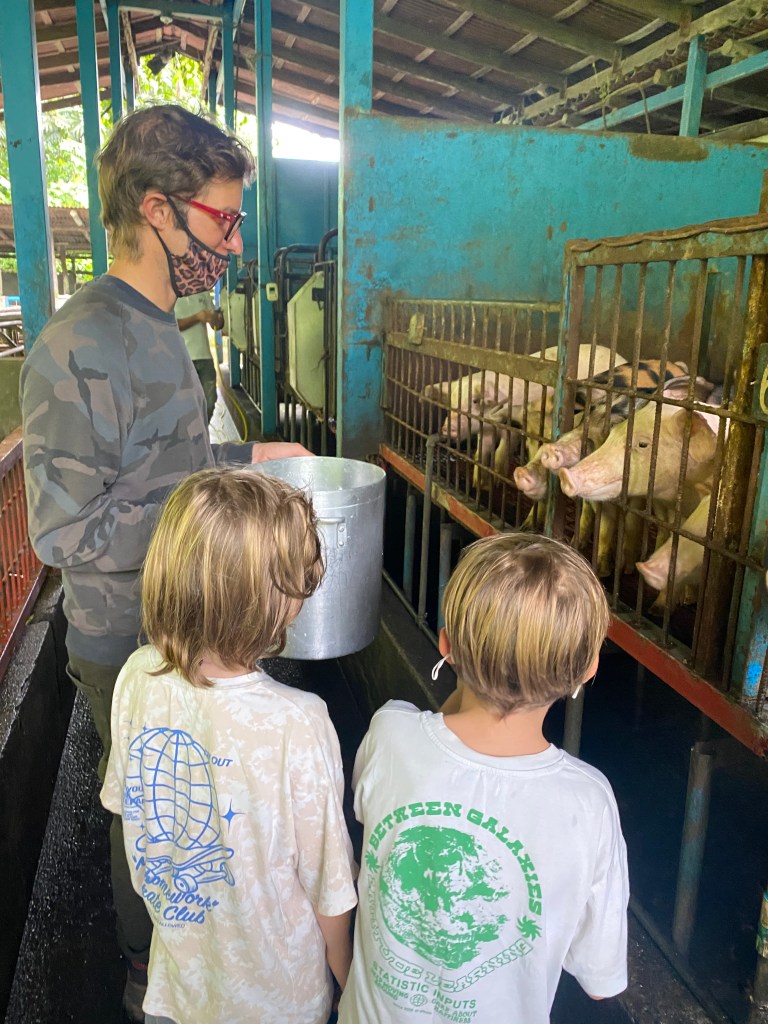
All the processes felt healthy with every step and output carefully worked out to optimise yield. All animals were cleaned out daily – I have never seen a cleaner chicken coop or healthier looking chickens. There’s a separate area for pullets and a separate quarantine ‘hospital’ for any sick birds. The kitchen has a very short timeline from farm to mouth and food requirements are carefully worked out so that there is little requirement for refrigeration.
Composting is an essential component of the closed loop system. The animals are brought in to be fed and the manure is collected at feeding time on a daily basis. Solids and liquids are separated. The liquids are used to create methane that is then used in the kitchen burners. The solid cow manure for example, is left for a week in one pen then transferred to a pen divided into 4 sections. Californian red worms are added to the freshest manure. The worms then move to the adjacent pen (through the wood slats) when the next week of fresh manure is added. The whole process takes about 5-6 weeks to create good manure for the garden. Another example we were shown, was the mountain forest fungi being combined with molasses and some other ingredients to create an organic fertiliser. Chemistry in motion!


We spent 6 days here and we loved every minute. It was an education and we only hope that Rancho Margot open source all their learnings so we can take some of them and apply it to our own farm projects. We drove away brimming with ideas and a realisation that it’s important to share journeys and learnings.
 Sky Yonder